


Discussing end-of-life wishes can feel heavy because it asks people to speak honestly about illness, death, family roles, and choices they may have avoided for years. The point is not to script every future moment. The point is to make sure loved ones understand what matters, where key information is kept, and how to act with less panic if a crisis arrives. A thoughtful conversation can reduce guesswork, prevent avoidable conflict, and give family members the comfort of knowing they are following the person's own words.
For many families, the hardest part is simply beginning. People worry that raising the subject will sound pessimistic, morbid, or disrespectful. In practice, the gentlest approach is often practical and ordinary: choosing a quiet setting, naming why the topic matters, asking one question at a time, and writing down what was agreed. If you need a structured way to keep care preferences, contacts, messages, and personal guidance together, create a private wishes record so the conversation leads to something your family can actually use.
Why do end-of-life wishes need a real conversation?
End-of-life wishes are personal, emotional, medical, cultural, spiritual, and practical. They may include where someone wants to be cared for, who should speak with doctors, whether certain treatments feel acceptable, what comforts matter, which people should be contacted, and what messages should be shared. Written forms can help, but families usually need the story behind the form. A daughter may know that her father prefers home, but not why familiar music, a window view, or a particular sibling's presence matters so much. A partner may know the medical decision-maker, but not the words the person wants used with grandchildren.
Australian resources on my problem is about planning ahead guidance make clear that future decisions become easier when people prepare before a crisis. The same principle applies inside the family. Conversations turn abstract documents into shared understanding. They also reveal gaps: an out-of-date emergency contact, a missing doctor name, an executor who does not know where documents are kept, or a wish that needs legal or clinical advice.
Evaheld's wishes checklist can help families move from broad concern to a practical list. The checklist should not replace legal, medical, or care advice. It can, however, give people a calmer starting point for the human details that formal documents rarely capture well.
How should you prepare before bringing it up?
Do a little preparation before you speak. Write down the reason you want the conversation, the decisions that feel urgent, and the areas that can wait. If you are talking about your own wishes, choose two or three priorities rather than arriving with a lecture. If you are inviting a parent, partner, or relative to share their wishes, begin with curiosity rather than a checklist. People are more likely to engage when they feel respected, not managed.
It also helps to know which topics belong in the first conversation. Start with values and comfort before documents. Ask what a good day would look like if health changed, who they trust to make decisions, what cultural or spiritual practices matter, and what would make care feel undignified. Resources explaining advance care plans show why values and preferences are central to future medical care discussions.
Then choose the right setting. Avoid public places, family events, and moments when someone is tired, in pain, or distracted. A quiet meal, a walk, or a planned video call can work better. Tell the person what you want to discuss before the conversation if surprise would make them anxious. A simple sentence is enough: "I'd like us to talk sometime this week about what would matter to you if your health changed, so none of us are guessing later."
What words make the first conversation easier?
The first words should be clear, kind, and modest. Avoid dramatic openers such as "We need to talk about when you die." Try a practical doorway instead: "I have been organising my own future wishes, and it made me realise we have never talked about yours." Or: "If something happened suddenly, I would want to make choices that felt right to you. Could we talk about what that means?" These openings explain the purpose without forcing the person to cover everything immediately.
If someone becomes defensive, slow down. You can say, "We do not need to decide anything today. I just want to understand what matters most." If they use humour, do not correct them unless it blocks the conversation. Humour is often how people make space for difficult material. If they change the subject, ask one smaller question: "Would you rather talk about medical care, practical documents, or messages for family first?"
The Evaheld piece on planning without awkwardness is useful because it treats discomfort as normal rather than as failure. A conversation can be successful even if it lasts fifteen minutes and covers only one topic. The aim is a path forward.
Which end-of-life wishes should families cover?
A useful conversation usually covers six areas: values, care preferences, decision-makers, practical information, personal messages, and review points. Values explain the "why" behind choices. Care preferences may include pain relief, home or hospital care, visitors, faith practices, food, music, privacy, and what dignity means to the person. Decision-maker discussions should identify who is trusted to speak with professionals, while recognising that formal appointment rules vary by location and may require legal advice.
Practical information matters because families in crisis need names, numbers, documents, and passwords handled appropriately. This does not mean sharing every password in a text message. It means explaining where secure records are held, which accounts matter, and who can access what. Cybersecurity guidance on account protection supports the idea that access planning should protect privacy as well as convenience.
Personal messages are often overlooked. A person may want to record thanks, apologies, stories, recipes, blessings, or advice for children and grandchildren. Evaheld's living legacy planning approach is helpful here because it frames wishes as part of a life, not only as instructions for a final stage.
How do you document wishes without turning it into paperwork?
Documentation should support the conversation, not flatten it. After talking, write a short summary in plain language. Include the date, who was present, what was discussed, what was decided, what remains uncertain, and what needs professional follow-up. If the person has formal documents, note where they are stored and whether they need review. If they do not, avoid pretending a family note is legally binding. Use it as a memory aid and a prompt for the next step.
For health and care issues, advance care planning resource resources emphasise the value of recording preferences before decisions become urgent. For family administration, government guidance on what happens after a death and death and bereavement shows how many practical tasks can fall to relatives. A clear record reduces the number of decisions people must make from memory.
Keep the record somewhere family can find it. If it is private, explain how access works. If it needs to be shared with a doctor, lawyer, executor, or substitute decision-maker, make that a named action. Evaheld's family document organisation guide can help turn wishes into an organised system rather than scattered notes.
What if the conversation becomes emotional or tense?
Emotion is not a sign that the conversation has gone wrong. Tears, silence, jokes, irritation, and avoidance can all appear when people are trying to talk about love, dependence, fear, and control. Stay with the feeling before returning to the task. You might say, "I know this is a lot. We can pause." Or: "I am asking because I love you, not because I want to rush anything." That reassurance matters, especially when a person worries the conversation is really about losing independence.
When relatives disagree, bring the focus back to the person whose wishes are being discussed. Ask, "What did Mum actually say?" or "Which option best reflects Dad's values?" If the disagreement is serious, consider a neutral professional, family mediator, counsellor, GP, palliative care team, or legal adviser. Relationships Australia can be a useful starting point for families who need support with difficult conversations.
Some families also need to discuss cultural obligations, blended family dynamics, old conflict, estrangement, or spiritual care. Do not force every issue into one sitting. Evaheld's communicate wishes guide can help families revisit the topic in stages rather than expecting one perfect conversation.
A practical checklist for discussing end-of-life wishes
- Choose a calm time and explain the reason for the conversation.
- Ask permission before moving into sensitive details.
- Start with values, comfort, dignity, and trusted people.
- Separate personal wishes from legal or medical documents.
- Record names of doctors, advisers, decision-makers, and key contacts.
- Document where important records are stored and how access works.
- Include personal messages, stories, thanks, and cultural practices.
- Confirm what should be shared now and what should remain private.
- Agree on one follow-up action, such as reviewing a document or speaking with a professional.
- Set a review point after major health, care, family, or location changes.
Emergency planning resources from the Emergency planning resources reinforce a useful principle: plans are easier to follow when people know them before pressure arrives. The same is true for end-of-life wishes. A calm conversation today gives family members a map for a future moment when they may be tired, grieving, or afraid.
How can Evaheld support the conversation?
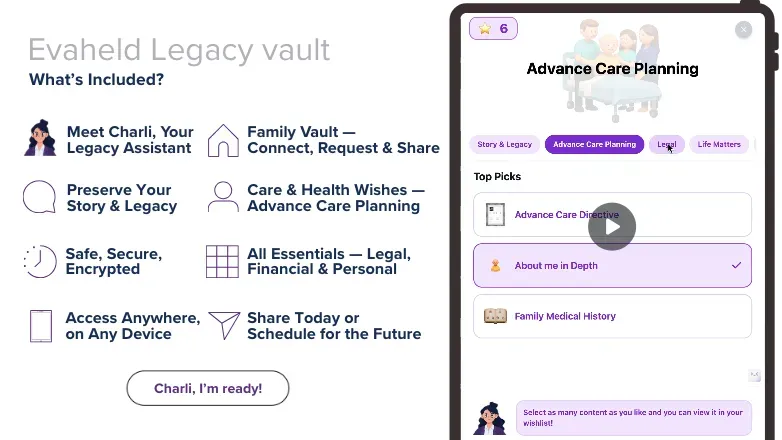
Evaheld can help families keep practical wishes and personal legacy material together. That matters because end-of-life planning is rarely just about forms. It is also about the stories behind decisions, the messages someone wants delivered, the family knowledge that should not disappear, and the reassurance relatives need when they are trying to honour a person well.
Families can use Evaheld to organise care preferences, important information, photos, videos, personal reflections, and messages in one private place. The end-of-life planning tools are most useful when they follow a real conversation, because the record then reflects the person's voice rather than assumptions. For carers, the evaheld support conversation guidance pathway can help keep support information visible across relatives who share responsibility.
Privacy still matters. Use secure account practices, limit access to the right people, and avoid putting highly sensitive passwords or financial details into casual messages. The careful handling of personal information is a reminder that personal information deserves careful handling even inside families. For digital records, the NIST Cybersecurity Framework also supports treating access, protection, and recovery as part of responsible planning.
If the conversation has already started, record your family's care wishes while the details are fresh. A short, clear record is more useful than a perfect plan that never gets written.
How should wishes be reviewed over time?
End-of-life wishes are not fixed forever. Health changes, relationships change, family members move, diagnoses arrive, beliefs deepen, and people sometimes revise what comfort means to them. Review wishes after a hospital admission, new diagnosis, move into aged care, bereavement, separation, birth of a grandchild, or change in the person trusted to make decisions. A review can be brief: "Does this still sound right? Is there anything you want to add or remove?"
For people preserving stories or family history, review is also a chance to add context. The United States National Archives offers practical advice on family archives, and the National Library of Australia provides a family history family history research guide guidance research guide. Those resources are not end-of-life forms, but they show why stable records, names, dates, and context matter. Wishes are easier to honour when they sit alongside the life story that explains them.
Making the next conversation kinder
Discussing end-of-life wishes is not about giving up. It is about reducing guesswork and making love practical. Start small, speak plainly, listen more than you explain, and write down what matters. If the first conversation is awkward, that does not mean it failed. It means the family has begun a subject that deserves patience.
The most useful outcome is not a flawless document. It is a shared understanding: what the person values, who they trust, what care should feel like, where information is kept, and what messages should remain for the people they love. When those details are recorded and reviewed, family members are less likely to feel alone with impossible decisions.
Families taking the next step may also find our legacy planning resources useful.