

What are the best grandparent memory book questions? Ask about one concrete part of life at a time: a childhood home, school routine, first job, migration, family tradition, relationship, difficult decision, practical skill, changed belief or message for a future grandchild. Specific prompts produce scenes, names and explanations that a generic request to “tell me your life story” usually misses.
This guide provides a substantial question bank and a practical system for finishing the book. It covers photographs, handwriting, recorded answers, uncertain dates, difficult topics, accessibility, privacy, backups and family contributions. The aim is a readable first edition with enough context for future relatives to understand the answers.
What are the best grandparent memory book questions?
Useful questions create an answer that another person can understand without being present. They ask who, where, when, what changed and why the memory matters. “What was school like?” is broad. “How did you travel to primary school, who went with you and what happened before the first bell?” gives the grandparent a scene.
Build the book around themes rather than chronology alone. Childhood, home, school, work, migration, relationships, parenting, grandparenthood, traditions, values, adversity and practical knowledge each deserve a section. Do not begin with the most painful period. Start with an ordinary place, object or routine so the grandparent can establish their preferred tone and level of privacy.
A finished memory book can accompany presents for grandma, but it should never be presented as a surprise interrogation. Give the questions in advance and let the recipient decide whether the book is written during, before or after the occasion.
Childhood home and neighbourhood questions
- Where did you live when you were about ten years old?
- What did the house look like from the street?
- Which room do you remember most clearly, and why?
- Who lived nearby, and how did neighbours help one another?
- What sounds, smells or foods take you back to that place?
- What work did children have to do at home?
- Where did you play, and what rules did adults set?
- Which shop, park, place of worship or landmark mattered to your family?
Ask for a sketch when a photograph does not exist. A simple floor plan can preserve room names, sleeping arrangements and everyday movement through the home. Label uncertain details as approximate rather than turning them into facts.
School, friendship and adolescence questions
- How did you get to school, and who travelled with you?
- Which teacher do you remember, and what made them memorable?
- What were the rules, uniforms and punishments like?
- Which subject came easily, and which was difficult?
- Who was your closest friend, and what did you do together?
- What music, books, films or radio programs mattered to you?
- When did you first feel independent from your family?
- What did adults misunderstand about young people at the time?
School memories may involve bullying, poverty, discrimination or interrupted education. Ask whether the grandparent wants those experiences recorded and who may read them. The memory book is not an investigation.
The National Archives of Australia offers family-history research guidance that may help verify dates and places without overriding personal memory.
Work, money and independence questions
- What was your first paid job, and how did you get it?
- What did you earn, and what did you do with the money?
- Which job taught you the most useful skill?
- What unpaid work did you do for family or community?
- Who helped your career, and how?
- Which workplace rule or custom would surprise people now?
- Which decision changed your working life?
- What money lesson did you learn through experience?
Record unpaid care, domestic work, volunteering and informal labour as work. A person's contribution should not disappear because it was not recorded on a payslip.
Migration, travel and changing places
- Which place have you left, and what do you still miss?
- What did you bring because it felt essential?
- Who helped you settle in a new place?
- Which language, food or custom did your family preserve?
- What became easier after the move, and what became harder?
- Which journey changed how you understood the world?
Place names may have changed and family spellings may differ. Keep the grandparent's wording, then add a note where another source uses a different form. Oral History Australia discusses ethical oral-history practice, including context, consent and the treatment of personal accounts.
Relationships and family-life questions
- How did you meet someone who became important to you?
- Which ordinary family routine do you hope people remember?
- What did becoming a parent, carer or grandparent teach you?
- How did your family celebrate birthdays, weddings or religious events?
- Which relationship changed after a difficult conversation?
- What did your family avoid discussing?
- Which person deserves to be remembered more clearly?
- What would you like younger relatives to understand about love and commitment?
Do not assume every relationship should be celebrated. Allow the grandparent to describe closeness, estrangement, chosen family and complex loyalties in their own terms. When an answer is intended for one person, a private version may be more appropriate than the shared reading copy.
Traditions, food and practical-knowledge questions
- Which recipe carries a family story, and who taught it to you?
- What did your family do every year without needing to plan it?
- Which object in your home has a history people may not know?
- What skill could you demonstrate better than describe?
- Which song, prayer, saying or joke belongs to your family?
- What did you repair, grow, make or organise in a distinctive way?
- Which tradition should continue, and which should change?
- What should a future relative know before using or giving away a family item?
Recipes need measurements, substitutions, equipment and the occasion they belong to. Heirlooms need names, previous owners and the reason they matter. What Is a Legacy Keepsake? provides a practical context checklist for objects, photographs and family records.
The U.S. National Archives explains storing family papers and photographs, while the Library of Congress lists recommended digital formats.
Turning points, hardship and recovery questions
- Which decision changed the direction of your life?
- What did you lose that changed what you valued?
- Who helped when you were under pressure?
- What mistake taught you something you still use?
- Which difficult period are you willing to record, and what boundaries should apply?
- What did recovery look like in ordinary daily life?
- Which advice would have been unhelpful at the time?
- What would you want a relative facing a similar problem to know?
Ask permission before using these questions. A grandparent may describe what helped without naming the event or people involved. If a prompt causes significant distress, stop. The purpose is preservation, not disclosure at any cost.
Better Health Channel explains that grief affects people differently. A family memory project should not claim to provide counselling or a guaranteed emotional benefit.
Values, beliefs and changed-mind questions
- What does a good life mean to you now?
- Which value guided a difficult decision?
- What belief have you changed your mind about?
- Which part of your identity has been misunderstood?
- What does fairness mean inside a family?
- When should a person apologise, forgive or set a boundary?
- Which principle do you hope younger relatives question rather than copy?
- What do you hope the family keeps doing after you are no longer organising it?
Keep contradictions where they show growth. A person can describe what they believed at 25 and what they think at 75. Do not edit several different answers into one supposedly universal family value.
Grandparenthood and future-message questions
- What surprised you about becoming a grandparent?
- Which ordinary moment with a grandchild stays with you?
- What would you like grandchildren to ask you while they can?
- Which skill, story or tradition do you want to pass on?
- What should a grandchild know before a major decision?
- What message would you leave for a future birthday or graduation?
- Which photograph explains one of your relationships?
- What do you hope future generations understand about the family's history?
Selected stories can become Best Gifts for Grandchildren That Last when they preserve a voice, skill or family explanation rather than adding another generic object. Future messages need a named recipient, occasion and review date.
Choose a book size the family can finish
A complete 30-question book is better than a 200-question project abandoned after six pages. Begin with five sections and four to eight questions in each. Set a pace that suits the grandparent, such as one question a week, one short session per visit or one section a month.
Give the questions in advance and allow handwritten, typed, recorded or dictated answers. The best gift for a grandparent is one that respects the person's energy and preferences. Do not use a celebration as a deadline that forces uncomfortable disclosure.
The W3C provides guidance on accessible communication. Use large readable type, strong contrast, short paragraphs and clear headings. Offer audio or a helper when handwriting is difficult.
Use photographs as evidence and prompts
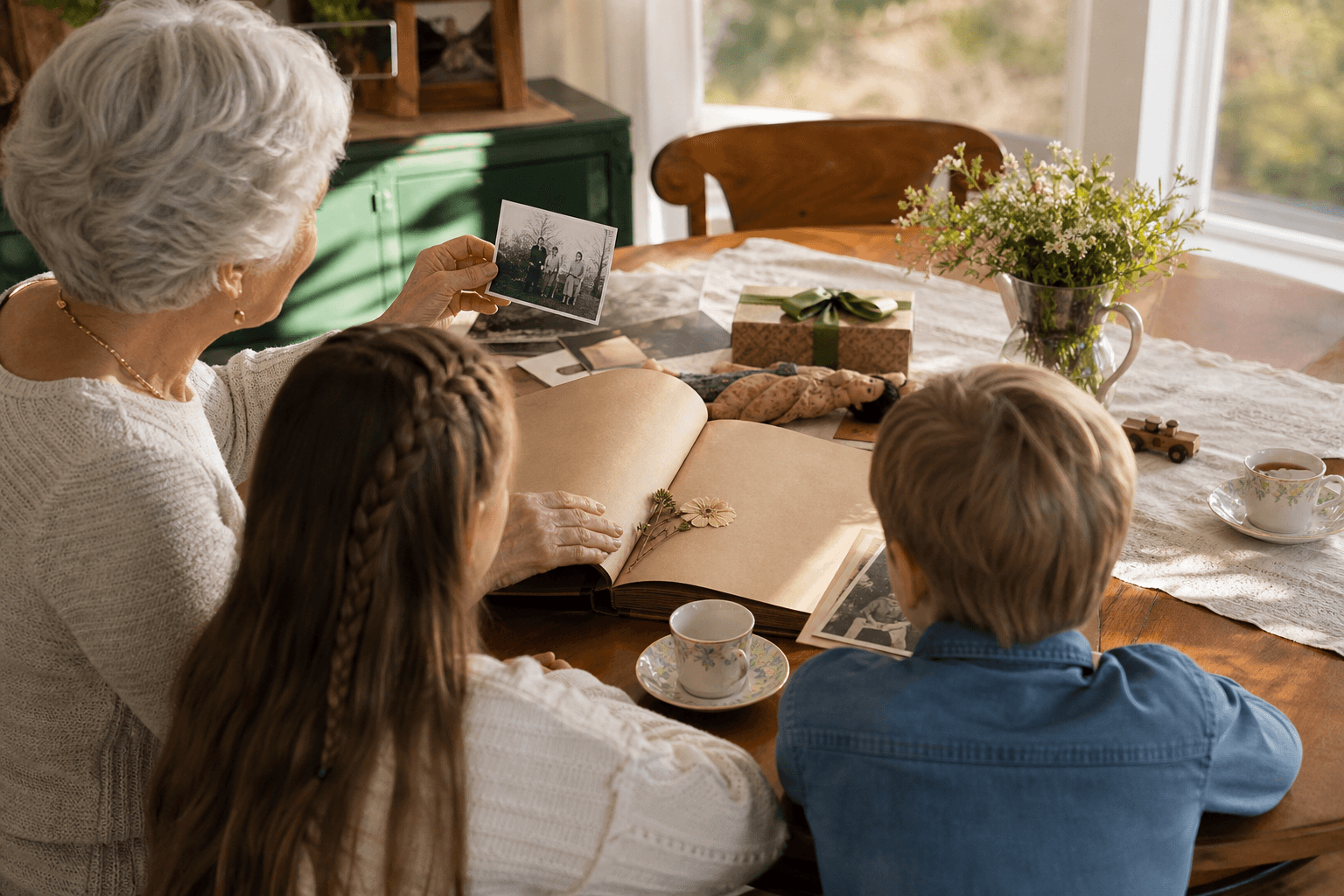
Choose a photograph because it supports an answer, not because every page needs decoration. Add every known name, the date or estimated period, location, event and the source of identification. When relatives disagree, record both accounts and note uncertainty.
Do not glue irreplaceable originals into a book without considering preservation. Use copies and store originals appropriately. Keep high-resolution scans separate from the layout file. The U.S. National Archives covers digitising family archives.
Record uncertainty without inventing facts
Memory is not a database. A grandparent may remember the people and meaning clearly while being unsure of the year. Write “about 1965”, “before the move to Perth” or “during my final school year” rather than guessing.
Use records to add context, not to cross-examine the speaker. Newspaper archives, certificates, letters and other relatives may help verify a date. Keep the original account and later correction together.
Adapt the project for dementia, fatigue or low vision
For dementia, use one familiar prompt at a time and avoid testing memory. Dementia Australia's guidance on staying connected supports communication based on current comfort and ability.
A large-print version, audio recording or dictated answer may suit low vision, limited dexterity or fatigue. When another person writes on the grandparent's behalf, distinguish direct quotations from summaries and let the speaker review the wording where possible.
Set privacy and access before sharing
Agree who can read the book and whether any answer should remain private, restricted until later or excluded from copies. Do not include another person's health, adoption, paternity, abuse or financial information without considering consent and harm.
The eSafety Commissioner's family privacy guidance can help with digital sharing choices. Use individual accounts, strong passwords and multi-factor authentication. The Australian Cyber Security Centre recommends password managers.
How Evaheld supports the reading copy and source archive
Evaheld can keep written answers beside scans, photographs, recordings and notes about who may see each section. A physical book can remain the family reading copy while original-quality files and spoken answers are stored separately.
Different Rooms can hold childhood stories, recipes, private reflections and future messages. Sharing one Room does not need to expose practical documents or unrelated family records.
Evaheld does not replace independent backups or preservation-quality originals. It provides the relationship and access layer: who supplied the information, what the answer refers to, who may receive it and when future material should be reviewed.
Create grandparent memory book questions in Evaheld by starting one Room, adding the first four answers and checking names, dates and recipients before expanding the project.
Common memory-book mistakes
- Using questions that are too broad: Ask for a scene, person, place or decision.
- Starting with trauma: Begin with ordinary memories and establish control.
- Creating an impossible project: Finish a short first edition before adding more.
- Correcting every detail: Record uncertainty without erasing the account.
- Using photographs without captions: Add names, date, place and significance.
- Editing out the speaker's voice: Preserve phrasing, humour and perspective.
- Ignoring accessibility: Offer large print, audio or dictated answers.
- Sharing private stories widely: Restrict sensitive sections.
- Keeping one copy: Preserve scans, originals and an independent backup.
- Never finishing: Set a date for the first complete edition.
Final grandparent memory book checklist
- Name the audience, purpose and preferred format.
- Choose five sections and 20 to 40 initial questions.
- Share questions in advance and permit changes.
- Use one concrete prompt at a time.
- Record names, dates, places and uncertainty.
- Use photographs to support stories, with complete captions.
- Distinguish direct quotations from family summaries.
- Set privacy and future-access choices.
- Keep originals, scans and independent backups.
- Finish a first edition before expanding the project.
FAQs about grandparent memory book questions
What are the best grandparent memory book questions? What to know
The best questions ask for one person, place, routine, decision or lesson at a time. A finished book can accompany presents for grandma when the story should last beyond the occasion. Oral History Australia's ethical-practice guidance supports clear purpose and consent.
How many questions should a first memory book contain?
Twenty to forty questions divided into short sections is usually enough for a complete first edition. The best gift for a grandparent is the format the person can finish. The W3C's accessibility guidance supports adapting print and digital versions.
Which objects should be included with the answers?
Use photographs, recipes, letters or ordinary objects only when they support a specific answer. What Is a Legacy Keepsake? explains the context to preserve, while the National Archives of Australia covers family-history research.
How can the book serve younger generations?
Choose stories and skills that help grandchildren understand family history without turning the book into instructions for every situation. Best Gifts for Grandchildren That Last shows how stories can move back to younger relatives. The U.S. National Archives explains digitising family archives.
Should difficult memories be included?
Only with the grandparent's permission and clear limits on who may read the answer. Evaheld's story and legacy vault can keep a restricted section separate. Better Health Channel discusses grief and varied responses.
What if exact dates are uncertain?
Use an approximate period and record the source of uncertainty rather than guessing. A private Digital Legacy Vault can keep later corrections beside the original answer. The National Archives of Australia provides research guidance for verification.
Can answers be recorded instead of handwritten?
Yes. Audio or video may suit fatigue, low vision or limited dexterity, and a transcript can become the printed book. Evaheld's story and legacy vault can hold both versions. Dementia Australia discusses communication and connection.
How should photographs be captioned?
Record every known name, the date or estimated period, place, event and why the image matters. What Is a Legacy Keepsake? provides the same context rule. The U.S. National Archives covers storing family photographs.
How can a memory book become a family gift?
Select a coherent set of answers, create an accessible reading copy and preserve source material separately. It can sit beside presents for grandma without turning the celebration into an interview. The eSafety Commissioner provides family privacy guidance.
How can Evaheld support the finished book?
Evaheld can organise scans, photographs, recordings, recipients and review notes in separate Rooms. Start with the complete first edition in a Digital Legacy Vault, then invite contributors after permissions are set. The Australian Cyber Security Centre recommends protected account access.
For a practical next step, explore what is a legacy.
For a practical next step, explore digital legacy.
Share this article