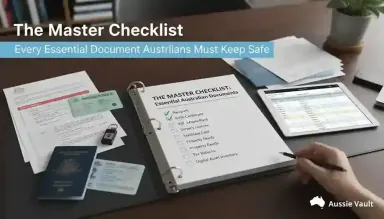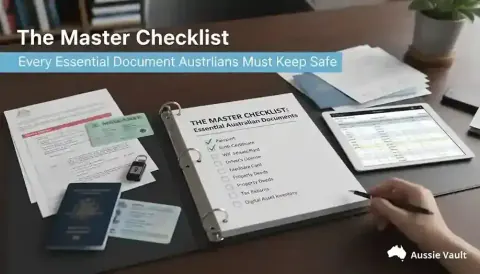
An essential documents checklist for Australians should do one practical job: help the right person find the right record at the right time. When illness, travel, a house move, a death, a hospital admission or a family emergency happens, loved ones rarely need a perfect archive. They need a clear map of what exists, where it is stored, who can access it, and which professional should be contacted first.
This Essential Documents Checklist Australia update is written for ordinary households, not only for people with complex estates. It covers legal documents, health records, money files, property details, digital accounts, identity papers, family instructions and legacy material. It is not legal, medical or financial advice. It is a practical organising framework you can use before your family is forced to search through folders, email accounts and half-remembered conversations.
The safest system separates three things. Formal documents belong with the relevant professional or authority. Secure copies and location notes belong in a controlled family record. Personal context, such as why something matters or who should be called, belongs somewhere trusted people can understand it. Evaheld's Essentials vault can support that family-facing layer without replacing a solicitor, accountant, doctor or government process.
Think of the checklist as an index rather than a storage box. The original will may sit with a solicitor. A certified copy may sit in a home safe. A medical summary may sit with a doctor. The checklist connects those locations and explains the order of action. That matters because family members under stress often lose time working out whether a document is current, whether a copy is enough, and who has authority to ask for help.
Good document readiness also protects privacy. You can give loved ones enough direction to act without handing over every sensitive detail today. A practical note might say that life insurance information is held in a named folder, that the policy contact is listed, and that a trusted person should call the adviser before making claims. That is more useful than a vague instruction and safer than scattering private numbers across notebooks.
What documents should every Australian list first?
Start with the records that would cause the greatest delay if nobody could find them. That usually means your will location, enduring power of attorney or equivalent documents, advance care planning papers, identity records, property documents, insurance details, bank and superannuation contacts, tax records, medical information, passwords process, phone access process, funeral preferences and key adviser names.
A checklist does not need to expose private details to be useful. For example, a family member may need to know that a password manager exists, where emergency access is described, and which device or email address matters. They do not need raw passwords sitting in an ordinary document. The handling personal information carefully explains why personal information should be handled carefully, especially when several people are trying to help.
Use a simple status next to each item: found, needs review, missing, or professional help needed. Found means the item exists and the location is clear. Needs review means it may be outdated. Missing means you need to create, request or replace it. Professional help needed means a solicitor, financial adviser, doctor, accountant or other qualified person should confirm the next step.
It helps to add a short confidence note as well. A birth certificate may be found and current. A will may be found but possibly outdated. A superannuation nomination may be uncertain because it has not been checked for years. A funeral preference may be a personal wish rather than a binding instruction. These distinctions stop the checklist from sounding more certain than it is, which is especially important when family members are trying to act respectfully.
Identity records: birth certificate, passport, driver licence, Medicare details, tax file number location, marriage or divorce records, citizenship or visa papers.
Legal records: will location, executor details, powers of attorney, guardianship appointments, trust deeds, property agreements and adviser contacts.
Health records: GP and specialist contacts, medication list location, allergies, private health insurance, advance care documents and emergency instructions.
Financial records: bank, superannuation, pension, insurance, debts, investments, business interests, tax files, regular bills and subscriptions.
Family and legacy records: personal letters, videos, recipes, family stories, funeral preferences, heirloom notes and messages for specific people.
How should legal and estate documents be recorded?
Legal documents need extra care because an informal note can create confusion if it conflicts with the formal record. List the document name, date, storage location, professional contact, review date and the person who should be told where it is. Do not rewrite legal instructions inside the checklist. Instead, record enough information for your executor or attorney to find the current document and seek advice.
The Queensland will information and Legal Aid NSW wills show why formal requirements and local rules matter. Your checklist can support that process by making sure family members know whether a will exists, where the original is held, which solicitor or trustee office was involved, and whether any related documents need review after major life changes.
Also record the practical estate information that legal documents may not explain. Your executor may need names of advisers, account contacts, property details, recurring bills, storage units, pets, vehicles, dependants, digital accounts and family members who should be notified. A clear checklist reduces guessing while leaving formal decision-making with the right authority.
Review legal and estate notes after marriage, separation, children, blended family changes, a new property, a business change, a major diagnosis, a move between states or the death of a named decision-maker. If the formal document changes, update the checklist on the same day so the family-facing version points to the current record.
For blended families and chosen families, clarity is even more important. A checklist can name the people who should be contacted, but it should not try to override legal authority or create secret instructions. Keep emotional context separate from formal directions. You might explain why a keepsake matters, who knows the family history behind it, or which relationship needs gentle communication, while still pointing back to the formal estate plan for legal decisions.
If you have no current legal documents, the checklist can still help. Record that the item is missing, add the next action, and book the appropriate appointment. Many people delay organising records because they feel the whole job must be finished at once. In practice, a visible gap is better than a hidden gap because it gives you and your family a clear next step.
Which financial records belong in the checklist?
The financial section should help a trusted person identify accounts and obligations without turning your checklist into an unsafe credential file. Record the institution, account type, adviser contact, broad purpose, storage location and whether there are linked cards, direct debits, loans or insurance policies. Keep passwords out of the document unless they are stored through a secure process designed for that purpose.
Include bank accounts, credit cards, mortgages, personal loans, vehicle finance, superannuation, pensions, shares, managed funds, business interests, insurance, tax records, regular bills, subscriptions, utilities, rates, strata or body corporate contacts, leases and major household costs. The Moneysmart estate planning resource is a useful reminder that wills, powers of attorney and financial organisation belong together.
For property and valuables, describe the item clearly enough that another person can identify it. A note saying jewellery is in the house is weak. A better record names the storage place, insurer, appraisal document, purchase paperwork and any family meaning attached to the item. The same applies to vehicles, collections, tools, artworks, business equipment and sentimental heirlooms.
If something needs urgent attention, make that visible. A rental property, business payroll, dependent adult, pet, insurance renewal, loan repayment or essential subscription may need action before the estate is formally settled. Your checklist is not there to make your family financial experts. It is there to stop avoidable confusion while they contact the right people.
Some financial records should be described by category rather than full detail. For example, a checklist can say there is a credit card with a particular bank, an accountant who holds recent tax papers, and a secure vault with policy documents. That tells a trusted person where to start while reducing the chance that private identifiers are copied into the wrong place. If a document contains account numbers, identification details or health information, treat it as sensitive and store it accordingly.
Household records deserve the same attention as investment records. Families often need to know how to keep utilities running, where spare keys are kept, which contractor manages urgent repairs, whether pets have medication, and which bills cannot wait. These details may look ordinary while life is stable, but they become important very quickly when the usual organiser is unavailable.
How do health, care and emergency records fit?
Health and care records are often the documents families need in a hurry. Record your GP, specialists, preferred pharmacy, medication list location, allergies, private health information, Medicare details, advance care planning documents, substitute decision-maker information and emergency contacts. If you support someone else, create a separate section for their care routines so your information and theirs do not become mixed.
Use plain language for values and comfort preferences. A family member may need to know who should be called, whether you have an advance care document, what routines calm you, which faith or cultural practices matter, and what privacy boundaries should be respected. The NSW after-death steps show how many practical tasks can arrive quickly, which is why health and family instructions should be easy to locate.
Do not use the checklist to give clinical instructions outside the proper process. Use it to point to the formal document, named decision-maker, doctor and questions the family should ask. This keeps the checklist useful without pretending to replace medical advice or state-based advance care requirements.
Emergency notes should be short. List dependants, pets, key locations, spare keys, alarm or access process, mobility equipment, essential routines, urgent household risks and people who should be contacted quickly. The checklist should help someone stabilise the first few hours, then hand over to professionals where needed.
For carers, the checklist should make routines visible without breaching unnecessary privacy. A separate care note might include preferred communication, meal routines, mobility aids, transport needs, support worker contacts, medication list location and warning signs that require professional help. Keep consent clear, especially when the information belongs to another adult. The point is to make continuity of care easier, not to spread private health details wider than needed.
Advance care records also need plain context. Formal documents can state decisions, but loved ones may still need to understand your values: comfort, dignity, faith, language, music, visitors, home environment or privacy. A short note can help family members advocate calmly while doctors and authorised decision-makers handle clinical questions.
What digital accounts and family memories need planning?
Digital life now sits beside legal and financial planning. List email accounts, phone providers, cloud storage, social accounts, password manager, devices, online banking portals, photo libraries, subscriptions, business platforms, domain names, creative work and any digital assets with financial or sentimental value. Record the lawful access process rather than writing passwords into a loose file.
Digital records can also hold the irreplaceable parts of family life: photos, voice notes, letters, recipes, videos, stories, family history, ethical wills and messages for future milestones. Evaheld's life admin planning helps connect practical records with the personal context that gives them meaning, especially when families need more than a list of accounts.
Review the digital section when you change phones, email addresses, two-factor authentication tools, storage services or recovery contacts. Old devices, expired phone numbers and abandoned inboxes can block access even when everyone knows the account exists. The checklist should answer the starting question: where does an authorised person begin without guessing private credentials?
Photos and family stories need a preservation plan as much as official records do. Identify where the main photo library sits, which folders contain family history, whether any voice recordings or videos should be saved, and who understands the people or places in older images. A folder of unnamed files may technically survive, but it can still lose meaning if nobody knows the story behind it.
If you use shared albums, social platforms or cloud services, record whether there are legacy contact settings, memorialisation settings or download options. Do not assume every platform works the same way. The checklist should record the account type and starting point, then leave access to the lawful process for that provider and jurisdiction.
A practical document review rhythm
Most households do better with a review rhythm than with a one-off sorting session. Start with one folder or vault area, then add records in passes. First, record what exists. Second, add locations and adviser contacts. Third, remove outdated versions or mark them clearly. Fourth, tell the right person where the checklist is stored. Fifth, set a review date so the system stays alive.
Use life events as triggers. Review your checklist after a move, new child, relationship change, property purchase, diagnosis, retirement, business change, death in the family, new adviser, new phone, new password manager or major travel plan. The Victorian probate information and Queensland death registration pages show how formal processes often depend on accurate names, dates and documents.
A quarterly mini-review can be enough for busy households. Check whether contact details changed, whether a document moved, whether a subscription or account closed, and whether a trusted person still knows where the index is. Then do a deeper annual review for legal, financial, medical and digital sections. Small reviews prevent the checklist from becoming another outdated document.
When reviewing, remove duplicate copies that could mislead someone later, or mark them clearly as historical. Families can lose time when several versions of the same document appear in different places. The current record should be easy to identify, and old drafts should not look like active instructions.
Before the FAQ section, choose one practical action. Put your current document list, adviser contacts and family instructions in one secure place, then tell one trusted person how to find that index. If you want a guided space for the family-facing version, you can build a document readiness plan in manageable sections.