

Finding an international online platform that promises a "100% free legal Will" is an attractive proposition for anyone trying to check off their estate planning on a budget. But as a savvy digital consumer, it is completely natural to look closely at a free offer and ask: What is the catch? How does this application protect my sensitive personal information? Many free international templates monetize downstream by cross-selling high-fee estate administration services or pushing aggressive charity bequest funnels. This review analyzes how free automated frameworks operate globally, looks at their compatibility with US state probate structures, and details how Evaheld offers an independent, subscription-free alternative through a secure storage model.
EveryWill, the Will-writing brand associated with Gathered Here, has a U.S. entry point advertising free Will creation. Use that U.S. service and its current terms rather than assuming an Australian offer applies unchanged. Confirm your state is supported, understand optional charitable and privacy choices, and complete the legal steps after downloading the document.
Digital Legacy VaultStart with the right country and company
Searching for Gathered Here can produce Australian reviews, funeral comparisons and EveryWill Will-writing results. Those results do not all describe the same service or jurisdiction. The U.S. EveryWill entry point identifies a U.S. offering and distinguishes its document tool from legal advice. The existence of that entry point matters: a blanket statement that the service is unavailable to Americans would be inaccurate.
Availability is still a more precise question than whether a website opens. Establish whether the tool currently supports your state, your place of residence and the assets you want the document to address. A country label does not prove a template fits every estate. Someone with a home abroad, a non-citizen spouse or a disputed family arrangement may need advice beyond what an ordinary questionnaire can determine.
Read an overseas review for background, then return to the terms attached to the actual U.S. flow. Do not import an Australian lawyer-review fee, probate quote or lifetime-access promise into a U.S. comparison without matching evidence. If you ask can you write a legal Will for me, the useful next distinction is who assembles the document, who gives individual advice and which law governs execution.
Separate the free document from everything around it
The published U.S. offer is free Will creation. That does not mean every possible estate service, professional opinion or later administration task is included. Establish what you can complete, save and download without payment. If a separate service appears, assess its scope and terms independently. A service being available alongside Will creation is not proof that buying it is a condition of receiving the free document.
Ask about updates with the same precision. Can you return to change answers, generate a new PDF and access an earlier version? Does a promise concern current access, an ongoing contractual commitment or a marketing description? Record the applicable answer rather than borrowing a promise from a different regional website. A changed draft also needs the correct execution process before it can replace the operative Will.
The Australian knowledge article about Gathered Here's free creation and updates explicitly discusses its Australian offer and partner support. It helps explain the brand's background. It should not be presented as a U.S. state-eligibility list or a substitute for the terms governing an American account. Regional distinctions protect readers from an apparently clear comparison that answers the wrong legal question.
Understand the U.S. self-service boundary
EveryWill's U.S. terms of service describe an adult, personal-use tool available in supported states, without individual review of the answers. The terms place responsibility for execution on the user and do not guarantee executor access after death. These are practical scope limits, not proof that an online-generated Will is incapable of being legally valid. Keep the distinction between a drafting service and a personalised professional engagement clear.
Before entering information, decide whether the questionnaire can express the decisions you actually intend. A form may handle ordinary gifts and appointments while being unsuitable for a contested exclusion, specialised trust or condition attached to a gift. Do not squeeze an important legal arrangement into an unrelated free-text field. A partly fitting document can create uncertainty precisely where the estate needs a clear instruction.
Seek help with complex estate matters when the consequences exceed the tool's scope. Useful triggers include a beneficiary receiving needs-based benefits, substantial foreign assets, a business succession agreement or a likely dispute over capacity. Price alone does not measure complexity. A family with modest savings can still need careful advice about ownership, dependants or a previous relationship.
Charitable giving should reflect your own decision
A free service can have a legitimate commercial or charitable funding arrangement. FreeWill, a separate U.S. provider, explains its own nonprofit-supported model. The existence of partner funding does not establish that a service is taking a deduction from every estate or requiring users to buy probate assistance. Evaluate a company's published policy and your actual selections rather than assuming one business model describes the whole industry.
Treat a suggested charity as an option to consider, not an instruction. Decide what you want to leave, whether a fixed amount or percentage fits your estate and what should happen if the organisation changes or closes. A percentage can adjust with the estate's size; a fixed gift may become disproportionate if assets shrink. An attorney can help with significant, restricted or conditional charitable gifts.
Check the recipient's legal identity rather than relying on a familiar logo. The IRS Tax Exempt Organization Search can help investigate status and filings. An organisation's trading name may differ from its registered name. A listing is not a complete assessment of suitability, financial performance or whether the particular gift achieves your tax objectives. Keep the organisation's identifying information with your supporting records.
PlansMake a deliberate privacy choice
Will-writing involves information about other people as well as you. Names, family relationships, dates of birth and intended gifts can be sensitive even when no account password is entered. Ask what information is necessary to assemble the document, which notifications you authorise and who may receive optional information. Do not assume a service is private merely because the result is not publicly posted while you draft it.
EveryWill's U.S. privacy policy distinguishes charity gift-detail sharing by opt-in from other operational and advertising practices. It also describes account deletion and privacy choices. Review those separate controls before submitting. Choosing a charitable gift, agreeing to share gift details and subscribing to marketing are different decisions. Keep a brief record of your selections so you can later identify what you want to change.
The FTC's explanation of website and app tracking helps distinguish browser cookies and advertising choices from the information you deliberately enter into a form. Private browsing is not a universal shield against online tracking. Use a device you control, close shared sessions and consider the available privacy controls without assuming one setting answers every question about handling estate information.
If you compare cloud storage services for important documents, assess permissions and recovery as well as file capacity. A folder that is convenient for you today may be inaccessible to an executor later. Conversely, sharing an entire folder can disclose beneficiary decisions or identification records to people who need only a location note. Plan access by purpose, with the minimum information each person needs.
Privacy rights also depend on where you live and which law applies to the business. The California Attorney General explains CCPA access, deletion and opt-out rights, including their conditions and exceptions. That is a California explanation, not a promise that every American has an identical right against every service. Use the provider's stated request channel and identify the information or choice you want changed. Keep the request and response with your records.
For example, you might want to stop marketing messages while keeping the document account, or change an optional charity-sharing selection while retaining the gift itself. Those are different requests from deleting the account and its stored files. Download the records you need before asking for deletion, and establish what copies must be retained for legal or operational reasons. A precise request is easier to resolve than an instruction to remove everything followed by a later request to recover the only copy.
Use a short preparation record before opening an account
Write down your legal name, state, family relationships, preferred executor and backup, intended beneficiaries and any guardian choices. Separately list the assets and how they are owned. Include property already held in a trust and accounts with beneficiary arrangements so that you do not assume the Will controls everything. Do not collect full financial credentials merely because you are preparing an estate inventory.
A what am I forgetting estate checklist can prompt omissions such as pets, outstanding loans, an alternative executor or an item with sentimental importance. Resolve uncertainty before turning it into a legal instruction. If you are unsure whether property belongs to you personally, jointly or through a company, identify the document or adviser who can confirm ownership. A questionnaire answer should reflect the actual position.
Keep instructions for children separate from the question of who manages their inheritance. A guardian nomination records an important preference, while the relevant legal process determines the appointment. Financial management may require a different person or arrangement. Personal context informed by a letter of wishes for my kids can explain routines and values without pretending that a private letter changes parental rights or replaces operative legal provisions.
Work through the document, not just the questionnaire
After generating the PDF, read the document from start to finish. Match every appointment and gift against your preparation record. Check names, addresses where included, substitute beneficiaries, the treatment of the remainder of the estate and what happens if a named person dies first. An answer that looked clear on a short screen may have consequences when assembled with the other clauses.
Ask the provider about an unclear output before signing it. Technical support may explain where a field appears or how to regenerate a download; that is different from advising whether a gift or trust is legally appropriate. If the issue concerns meaning, rights or competing interests, seek legal advice. Keep the question and response with your own records so that the reason for any revision is understandable later.
Separate power of attorney decisions in estate planning concern a different function from an executor appointment after death. Do not assume a free Will includes authority for someone to manage your finances during incapacity. Make a list of the separate documents your circumstances require, and check the signing requirements for each. A package name is not a substitute for understanding the actual documents.
PrivacypolicyExecute the Will under the applicable state rules
Printing, witnessing and any notarial step must follow the law and procedure applicable to the chosen Will. States differ, and special circumstances can change what is required. The price of the tool does not determine those rules. Do not treat electronic acceptance of website terms, typing your name into a draft or saving a signature image as proof that a Will has been validly executed.
For comparison, the separate provider FreeWill describes its download and signing process, including a different notarial requirement for Louisiana. That illustrates why a single generic instruction such as two signatures is insufficient for every U.S. situation. Use the instructions for your document and state. If you need an electronic or remote procedure, establish that the specific method is legally available and correctly implemented.
Make the signing appointment manageable. Arrange suitable witnesses, prepare identification if a notarial act requires it and use the final complete version. Avoid leaving blanks or exchanging pages after signatures have been obtained. If a problem occurs, ask how to correct it rather than improvising an unexplained alteration. Keep drafts distinguishable so a family member does not later mistake an unfinished copy for the executed original.
Keep the original independent of the platform
Store the signed original in a place the appropriate person can reach and record its exact location. Maintain a clearly identified reference copy. The provider's continued operation, a remembered password and the availability of a family member's email account are separate practical dependencies. Reducing those dependencies is sensible for a free or paid service. It also prevents an account-deletion decision from becoming a document-location problem.
An executor checklist should identify relevant people, records and outstanding tasks without implying that the nominated executor has already been appointed by a court. California Courts explains the distinction between a Will and the administration of property after death. Having instructions does not automatically remove the need for probate or another legally required transfer process.
If you want a spouse or relative to help with practical preparation, preserve your own independent decisions and follow the provider's account rules. Discussing an asset list is different from someone else choosing beneficiaries or operating your personal account. If typing, language or disability creates a barrier, ask about an appropriate assistance route. A free service that you cannot use safely may be less suitable than accessible legal help.
Review alternatives without equating free with unsuitable
A U.S. free tool, a statutory form where available, a paid self-service product and an attorney's tailored drafting can each serve different circumstances. The Legal Services Corporation's legal-help finder identifies local legal-aid organisations for eligible people. Availability and estate-planning scope vary. Ask what help is offered before assuming that a free consultation covers preparing every document you need.
Compare the whole task: expressing instructions, understanding the result, executing it, retaining the original and reviewing it after a change. A service may perform some of those tasks while leaving others with you. A personal legacy message has a different purpose again. Understanding ethical Will differences prevents a meaningful family letter from being mistaken for a legally operative inheritance document.
Account security also matters. The FTC's phishing guidance explains why an unexpected message requesting account or payment information deserves independent checking. Visit the service through its known address rather than an unverified message. Keep the email account used for sign-in secure. A fraudulent contact can imitate a reputable free or paid provider; the existence of a scam does not establish misconduct by the real company.
How Evaheld fits into the practical plan
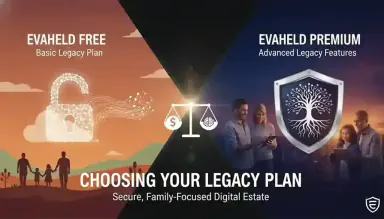
Evaheld enables users to create Wills and organise related estate essentials, care wishes, digital account records and legacy material. Users can complete, update and share relevant information with trusted people. An online-generated Will can be legally valid when the applicable requirements are met. Use the platform's organisational value alongside the execution steps, rather than treating an organised digital workspace as a substitute for them.
Arrange emergency access without sharing passwords through appropriate instructions and permissions. The person who needs to locate a signed Will may not need all the private messages or account details stored alongside it. Review what is shared, with whom and for what purpose. Record legal authority separately from practical access, especially where an executor, healthcare agent and family helper are different people.
Planning for protected digital assets also means deciding which details should remain outside the Will. Keep private recovery information out of broadly circulated drafts and record a secure access arrangement instead. If changing platforms, download necessary records before closing the old account and identify the operative document. Avoid leaving relatives with several inconsistent versions and no explanation of which one was signed.
Final checks for a U.S. free-Will offer
- Use the U.S. entry point and identify the company and terms governing the account.
- Establish that your state and circumstances are supported.
- Confirm the free creation, download and update rights actually offered.
- Treat optional services and charitable gifts as separate decisions.
- Check a charity's identity and record your intended gift accurately.
- Review data-sharing choices and authorised notifications.
- Read the assembled document and resolve unclear legal instructions.
- Follow the applicable execution procedure for each document.
- Preserve the signed original and tell the appropriate person where it is.
- Review the plan after a move or important family or financial change.